

Sudley House in Liverpool is a true architectural artefact that preserves the spirit of the Victorian era. This house-museum, nestled among the green hills of Mossley Hill, impresses with its subtle elegance and historical integrity. Its facade, in a Neo-Greek style, and its interiors, which have retained their original decorative elements, create an atmosphere that transports visitors back to the 19th century. In this article on liverpool-future.com, we will talk more about the architectural soul of Sudley House.
Walls that remember: The story of Sudley House in brick and wood
Sudley House in Liverpool is a building that is interesting because it embodies an entire era. Its function of preserving art isn’t the only thing it’s good for; the building’s architecture itself is art. It was built in 1824 for the wealthy merchant Nicholas Robinson, a man who would later become the Lord Mayor of Liverpool. The architect was likely John Whiteside Casson, although no confirmation of this remains. The building was distinguished by a classic symmetry, natural to the Victorian tradition, with a facade in a strict Neo-Greek style.
The history of Sudley House cannot be imagined without the Holt family. In 1883, the estate was purchased by the shipowner George Holt, one of the men who shaped Liverpool’s maritime identity. After moving into the house, he transformed it into something more. He changed the main entrance and added a veranda, partially redeveloping the interiors while preserving a sense of intelligent subtlety. It was George who established his art collection here, which can now be seen by everyone.
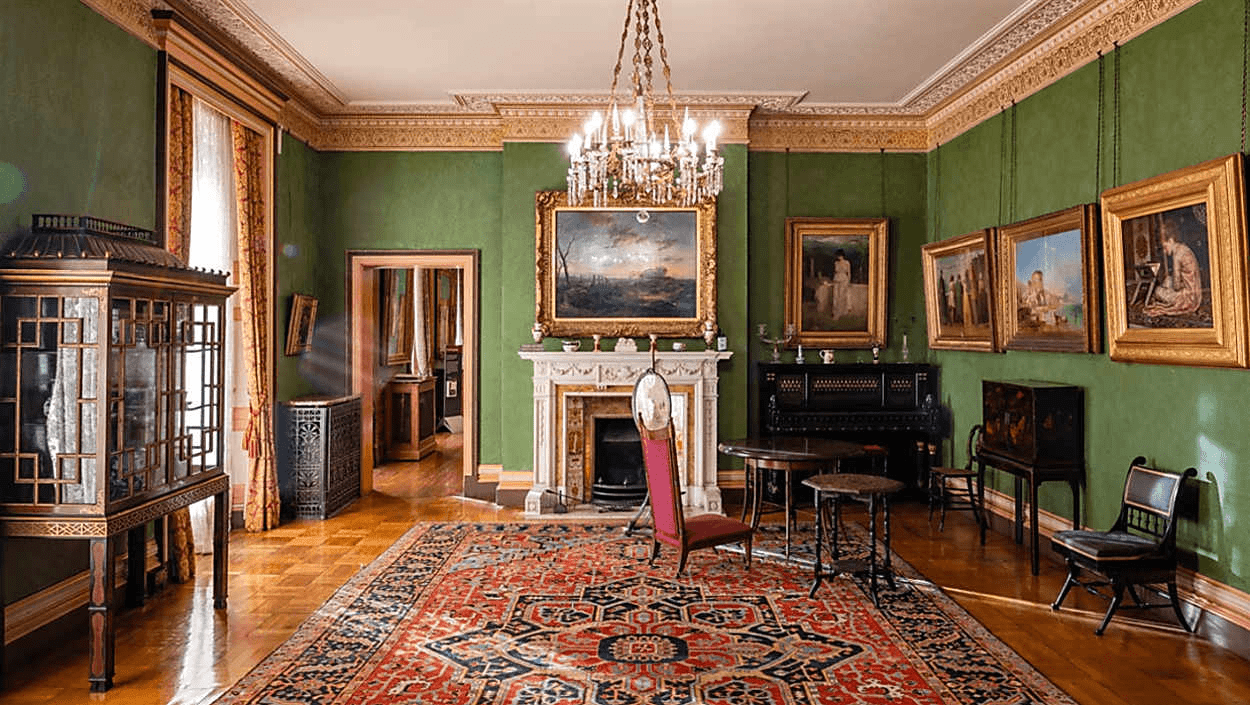
After the death of George’s daughter, Emma, in 1944, the house and everything it contained were donated to the city. But instead of turning it into another administrative building or private club, it was decided to preserve the spirit of a home—Sudley House opened as a museum. It wasn’t unrecognisably renovated or replaced with a new building but was preserved with respect for the original.
Victorian elegance in the details: interiors, layout, and atmospheric touches
Sudley House in Liverpool is impressive not for its facade—which is restrained, even modest—but for what’s inside. The Victorian spirit here isn’t theatrical or faded. You can feel it in the silence of the library, in the curves of the stained glass, and in the whisper of the wooden panels.
In the hall, visitors are greeted by an 1880s stained-glass window—a female figure with the inscription Veritas (Latin for Truth). It’s the work of the Shrigley and Hunt studio and is one of the few original details that have survived in the house since Emma Holt’s time. She is the person most often associated with Sudley House; the last resident transformed the house into a place of beauty, peace, and refined taste.
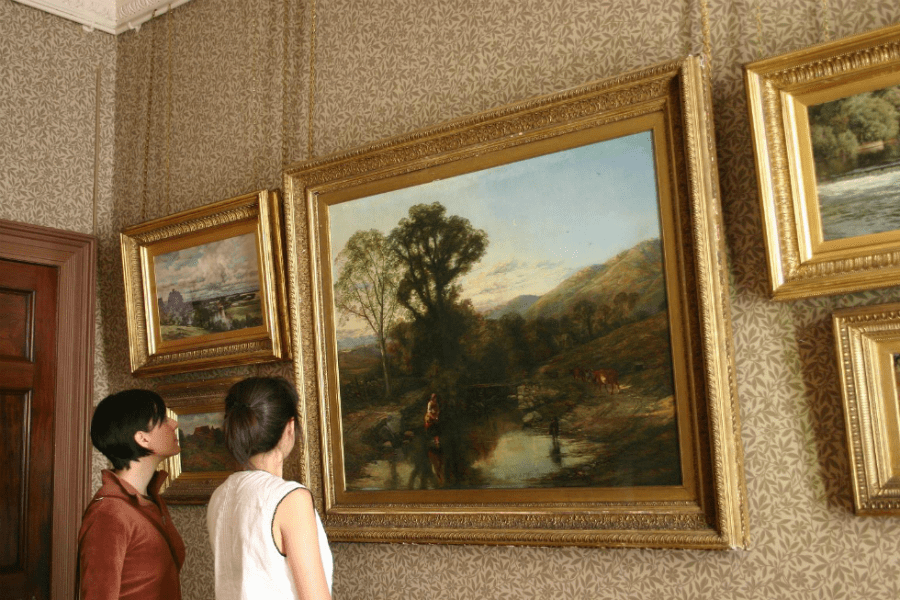
The library is rich with texture. The walls are covered in dark flocked wallpaper—a typical element of the Victorian style that adds depth and tactility to the space. Its velvety surface creates an atmosphere of concentration where time seems to stand still. Everything here encourages quiet: the heavy mid-19th-century wooden cabinets with their distinctive carved facades and the soft light that filters through the dense curtains. This isn’t a prop for a tourist but a genuine environment from the past that doesn’t try to be “museum-like.”
The dining room contains many symbolic elements. The white marble fireplace is adorned with the Holt family crest. Such things serve as a kind of signal—a sign that this house was not a temporary refuge but a centre, a point around which life was built.
Although much of the furniture was sold after Emma Holt’s death, the museum team is gradually restoring the interior. There is no excess here, only style and respect for the original. That is why Sudley House attracts researchers of the era who are interested in the interior not as a set piece but as an environment where people once lived.
Symbols of an era: The fireplaces of Sudley House
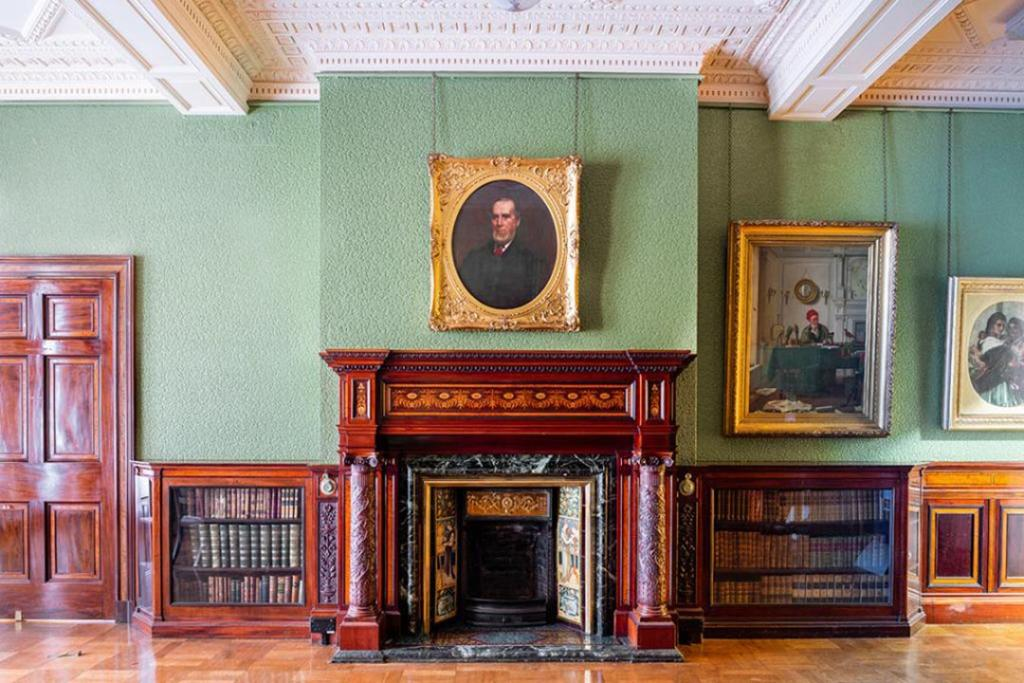
The fireplaces at Sudley House are not limited to their primary function of providing warmth. They are witnesses to time, preserving the stories of the Holt family and the aesthetics of the Victorian age.
In the vestibule, visitors are greeted by a fireplace with a carved wooden surround, made by the Liverpool workshop J. O’Neill. Its tiles are Dutch majolica featuring everyday scenes, which adds a cosy, homely feel to this part of the interior.
In the library, a fireplace with marquetry and columns, also by J. O’Neill, takes centre stage. The tiles, with female figures symbolising art and music, were made by the Shrigley and Hunt workshop. These elements reflect the family’s passion for the arts.
The dining room is decorated with a red marble fireplace in an Italian style, with griffins and musical motifs. The central place is occupied by the Holt family crest—a sign of their elite status and pride.
In the living room, there’s a fireplace of white and coloured marble, with brass inserts. The tiles with female figures holding fruit and grain symbolise fertility and abundance.
Each fireplace at Sudley House is a part of history, telling the story of the Holt family’s tastes, values, and lifestyle. It is a wondrous beauty that does not fade with time.
Interior design researchers of the Victorian era are very fond of this architectural gem. They are particularly captivated by the combination of functionality and restrained luxury. This is what sets Sudley House apart from the elite homes of its time. It’s simpler, but that’s what makes it more appealing. You might also be interested in the architecture of Croxteth Hall.