

Anfield stadium is a true jewel of the city of Liverpool and its pride, according to liverpool-future. It’s hard to believe, but it was once used by Everton, their fiercest rival and main competitor for the hearts of fans in the city. The arena was awarded a four-star rating by UEFA and hosted some matches during Euro 96 in England.
Modern-day look, key information
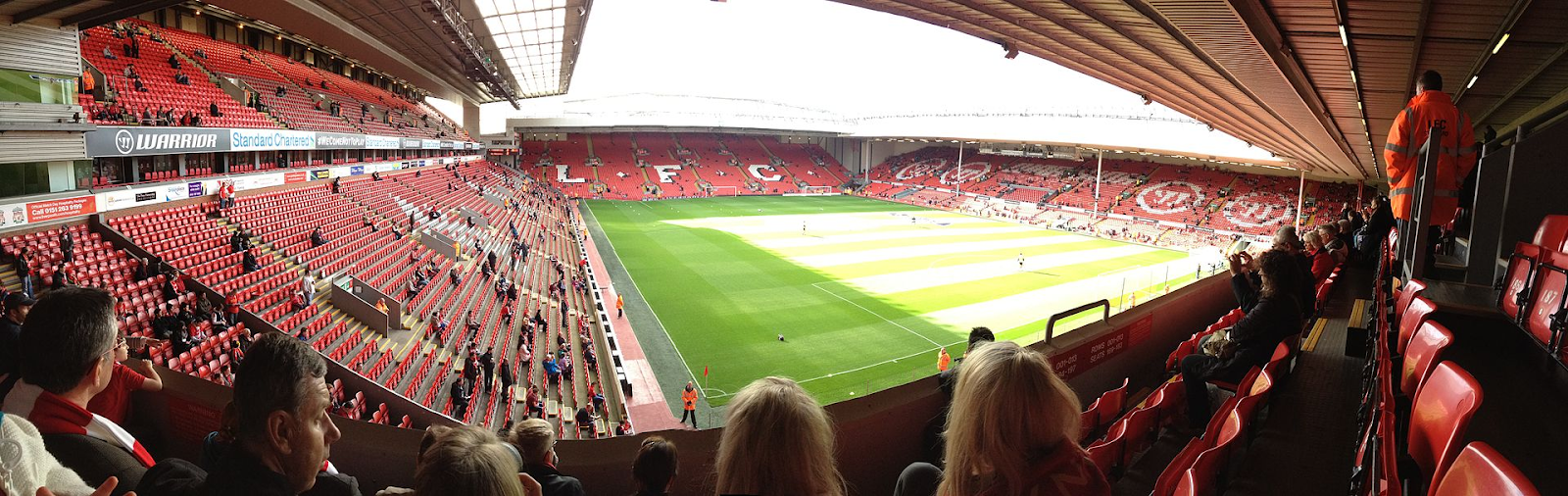
Today, Anfield is a real beauty, made up of four stands, each with a distinct name: the Spion Kop, the Main Stand, the Centenary Stand, and the Anfield Road Stand. Their total capacity until recently was 54,074. However, before the recent renovation, the attendance record, set in 1952, was 61,905 spectators because back then there were benches rather than individual seats, so attendance records could exceed the nominal capacity. Some spectators were even allowed to stand. Tragic events later led to stadiums being built with individual seats to prevent crushes.
The renovation, carried out between 2021 and 2023, increased the stadium’s seating capacity to 61,000, with 1,800 seats offering an enhanced level of comfort. Before this, there was an idea to build a completely new stadium, but it was abandoned in favour of renovation. The issues that led to these changes were not only the insufficient capacity for a club like Liverpool but also the frankly paltry number of parking spaces.
The entrance gates to Anfield are named after former Liverpool managers, Bob Paisley and Bill Shankly. A monument was even erected to the latter in the stadium’s forecourt.
The stadium’s evolution
The stadium was built in 1884. Initially, Everton played there, but they moved to Goodison Park and stopped playing at Anfield in 1892, after which their rivals began playing there. That’s when Liverpool FC came into existence. Although there were already stands on the ground where the “newborn” club started playing, a new one was built, and an additional eight years later, the original stand known as the Anfield Road Stand appeared.
In the 1909-10 season, a storm occurred, after which the stand required repair work. There was also an idea to create a three-tier stand, but it was never realised.
For a full 60 years, Anfield’s appearance didn’t really change. But the need for change was definitely coming. Bill Shankly created a legendary team and wanted it to execute set-pieces flawlessly. The stadium had to match the team’s level. So, in the 1960s, things started to change.
First, a new stand, the Kemlyn Road Stand, was built on the side that is now named after Dalglish. Two years later, Anfield was expanded, creating a larger area for spectators with standing places. A roof was added to it in 1965.
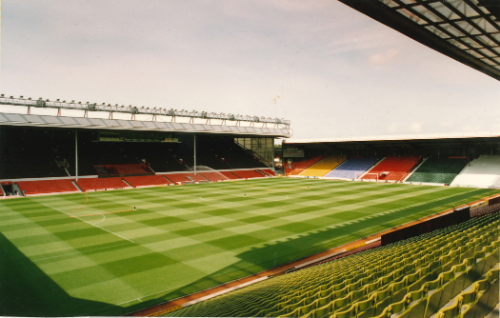
The Liverpool stadium remained in that state until 1982, when more seats were added. The manager at the time, Bob Paisley, asked that they not be just red, and his request was granted. Red is Liverpool’s traditional colour, but that’s not the only colour in the world. Plus, when the reserve teams played, the stadium was less full than usual for those matches, and Paisley felt that the players in red blended in with the seats of the same colour. So, green, yellow, blue, and white sections were also added to the stands.
It was at that time that the Shankly Gates were unveiled in honour of the former manager who had died shortly before. They were originally located at the corner between the Main Stand and the Anfield Road Stand, but after the 2016 renovation, they were moved to the opposite corner.
Adding tiers and rail seating
For over 90 years, the Anfield Road Stand consisted of a single tier. But in 1998, local builders created a second tier, adding more seats. The next modernisation also allowed for the creation of rail seating, which enabled spectators to support their favourites during key moments of the game without worrying about their safety.
2021 was a landmark year for Liverpool’s home ground, as it was expanded with over 6,000 new seats. These are the changes mentioned at the beginning of this article.
Future expansions
In the Liverpool of the future, Anfield stadium will certainly hold its place of honour, and it is set to be even better than it is at the time of writing. It is worth noting that the Liverpool City Council is concerned about the fate of the city’s main stadium and is actively involved in planning its improvement. Specifically, the expansion of the LFC home ground between 2021 and 2023 was not without their involvement.
The managers, or coaches, of the Reds also show an interest in the stadium’s condition. For example, Jürgen Klopp laid the first spade in the ground at the opening ceremony, personally starting the construction work related to the aforementioned renovation.
And one of the last major changes to the architecture, or rather the exterior, of the stadium was the installation of a 550-kilogram club crest. History shows that the pursuit of perfection never ends. Future major changes and expansions of the arena are quite likely. Do you have any specific ideas for improving the stadium?