

In Liverpool’s wonderful Georgian Quarter, at the intersection of Hope Street and Mount Street, stands an unusual piece of public art that makes passers-by stop and think. This amazing artwork, titled A Case History, was created by sculptor John King in 1999 and depicts several suitcases piled up, as if waiting for their departing or newly arrived owners. You can find out what it all means on the liverpool-future.com website.
A little about the artist
John King, born in Liverpool in 1957, is an artist with an individual style, whose works are distinguished by their special originality. The thing is, he creates his art from things that most people simply throw away. These include old newspapers, battered furniture, worn-out bags, and pieces of window frames. The artist admits that he most often finds materials for his creations in abandoned houses in Liverpool.
His works seem simple, but only at first glance, as every object holds an entire story. John King doesn’t just collect useless household items; he makes them tell a story. For example, structures made from old door frames, pieces of furniture, and plaster remind viewers of the houses in Liverpool destroyed by bombing; a labyrinth of books becomes a keeper of memories; and the famous A Case History artwork references the history of the city.
The uniqueness of John King’s work lies in his immense respect for the objects he creates his masterpieces with. He doesn’t rework or improve them, nor does he paint over scuffs and cracks; he simply arranges them according to his vision, allowing each object to tell its own story. The artist often mentions that his main task is to find beauty in the everyday and to remind the viewer that behind every discarded, forgotten, and useless item lie the real lives and emotions of people.
What was the artist trying to say with his installation?
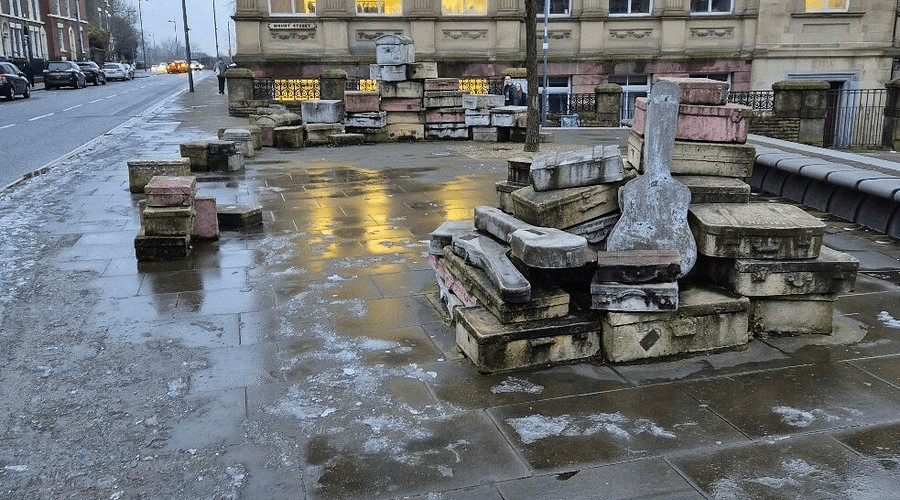
A Case History is one of John King’s most famous works, executed in his usual style. Old suitcases with scuffed corners that no one needs anymore, musical instrument cases, large travel trunks, and leather bags—all are brought together in a single ensemble that looks very harmonious.
The key to understanding this artwork lies in Liverpool’s history. For centuries, as a port city, it welcomed and sent off a huge number of people. Thousands of emigrants passed through its docks, seeking a better life in the United States, New Zealand, and Australia. Others, on the contrary, returned to Britain or came here as emigrants or visitors. Thus, A Case History is a kind of memorial to all those who once arrived in this country or left it, for whom a suitcase was a symbol of a new, happy life.
For us, modern viewers, these objects symbolise the lives of different people—travellers, workers, emigrants, refugees—everyone who spent at least some time in this city. Looking at these suitcases from the past, you can’t help but wonder whose belongings were in this or that bag. Where and why was its owner travelling? What emotions did they feel at the time?
It seems that the materials used to make the suitcases and their finishes—leather, wood, and metal—are also symbolic and have their own meaning. Unlike the suitcases of today—lightweight, plastic, or fabric, and equipped with wheels—these sturdy, heavy items were designed for very long use. And here they are in front of us, while their owners have, in all likelihood, long since passed. It makes you contemplate the fragility and fleetingness of life.
What does the artwork look like today and what is its future?
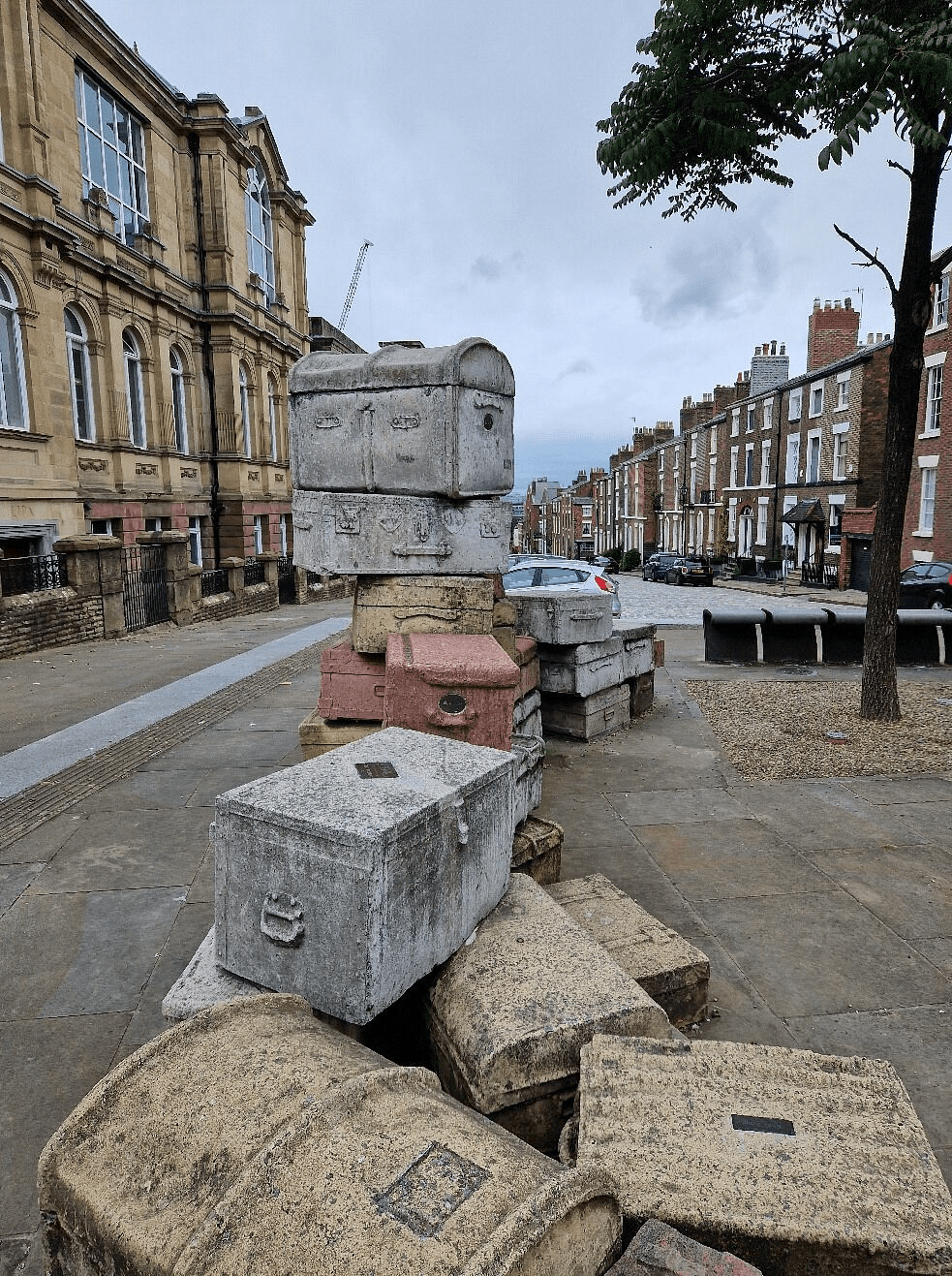
Today, the installation, which is located in the open air, has not lost its former appeal, although the rain, fog, and snow are taking their toll—the wooden trunks have darkened, mould has appeared in places, metal details have rusted, and the leather handles and straps have cracked. Strangely, all this doesn’t spoil A Case History at all—on the contrary, time only adds to its depth and charm. Passers-by are still keen to approach the old bags, examine them, touch their rough surfaces, and exchange speculations about who this or that suitcase belonged to.
The question of what will happen to the installation next remains open. Cultural organisations and Liverpool City Council periodically hold meetings about the fate of A Case History, planning to restore and move the artwork indoors to protect it from the negative effects of the weather. However, many residents hold a different view: let the suitcases stay where they are; let them gradually turn into ruins—this would be another reason to ponder and reflect. For example, on the fact that nothing is eternal, that everything in the world comes to an end—everything except memory.
What will be decided next is not yet known, but one thing is clear—King’s suitcases have long become a part of Liverpool. Residents and tourists love them; people take photos, think, reflect, and debate here. If you find yourself on Mount Street, be sure to visit this artwork—maybe one of the bags will tell you its secret? And if you want to feel the atmosphere of this amazing city even more deeply, pay attention to the old Liverpool churches—each of them has its own unique history and architectural features.