

Liverpool Anglican Cathedral is rightfully considered one of the local architectural masterpieces. It was designed by Sir Giles Gilbert Scott. Learn more about the features of its design and the history of creation at liverpool-future. You would probably be very surprised how long it took to build this church!
Chronology of creation
Liverpool Anglican Cathedral is also called the Cathedral Church of Christ in Liverpool. It is one of the most ambitious architectural projects of the 20th century. When its construction began in 1904, the above-mentioned architect was only 22 years old. The work was completed only in 1978! Such a long period of construction is explained by two world wars and significant changes in architectural trends that took place at that time. Let’s recall the events in chronological order.
- 1880 — Liverpool officially received the status of a city, which was an important stage in its development. In the same year, the Liverpool diocese was created, separately from the Chester one. St Peter’s Church on Church Street (not to be confused with Liverpool Metropolitan Cathedral) was designated as a pro-cathedral, that is, a temporary place for worship until the construction of the main cathedral was completed.
- 1901 — the city hall decided to build a magnificent Anglican cathedral
- 1904 — the foundation of the cathedral was laid
- 1910 — the first part of the building, the Lady Chapel, was consecrated
- 1924 — the church was consecrated
- 1939 — World War II slowed down the construction
- 1960 — architect Giles Gilbert Scott passed away
- 1978 – a solemn service dedicated to the completion of the cathedral was held in the presence of Queen Elizabeth II. This event symbolised faith in the future and became a landmark moment in the history of the city.
It goes without saying that the cathedral has become the city’s important cultural and religious centre.
Architecture: Gothic accent
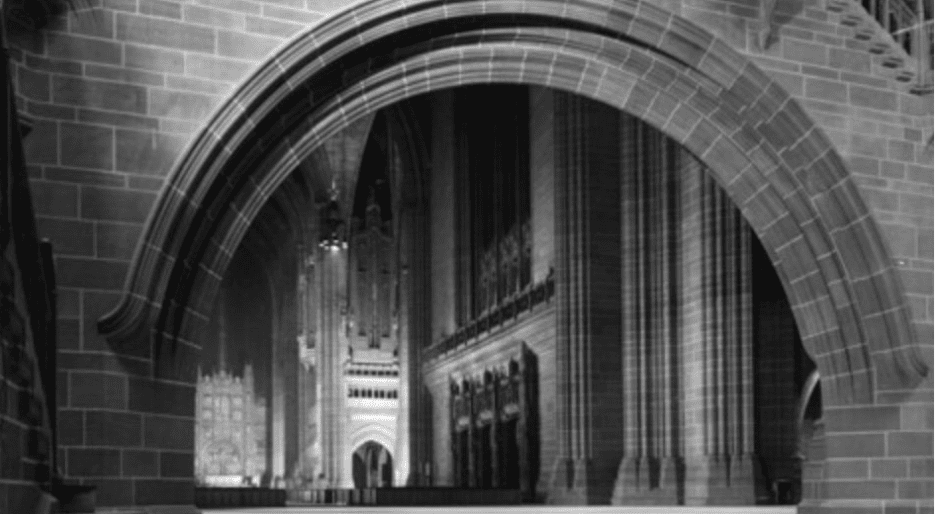
Liverpool Cathedral stands out as the most traditional among the new English churches built in the 20th century. Its architecture is largely based on the Gothic style.
Interestingly, before winning the competition for the cathedral’s designs, architect Scott had no professional experience. He joked that previously, he had designed only a pipe stand. At first, he was assisted by a mentor, a master of his craft, Bodley. However, he died in 1907, so Scott had to control the design by himself.
Things didn’t go well and Scott had to revise the original design in 1910. He abandoned the idea of two transepts in favour of one huge central tower, which eventually became the building’s distinguishing feature. Thus, the plan wasn’t just “bare” Gothic but also included classical monumentality.
Scott sought to achieve grandeur not through details but through scale and proportions, which changed both the exterior and the interior. The interior was designed multi-layered, creating an atmosphere of mystery. Despite the criticism of modernists, the building harmoniously combines styles and integrates sculpture into the architecture. The cathedral is recognised as an outstanding example of 20th-century British architecture and its completion in 1978 marked the union of tradition and innovation.
The height and design of Liverpool Anglican Cathedral are simply amazing! Giles Gilbert Scott was the main designer, but the statues, stained glass and furniture also reflect the ideas and wealth of the city’s merchants who financed the project. Scott’s memorial inside the church is a symbol of his achievement as an architect. He is remembered by all who come to hear sermons or pray.