

“Goodison Park” is the home ground of Liverpool football club Everton. For millions of fans, this was an undeniable truth for over 130 years, until it was announced in the 2020s that the club would be moving to a new stadium. Does this make the Toffees’ fans feel nostalgic? You bet it does! But these things happen from time to time, and for many reasons. This event, scheduled for the start of the 2025/2026 season, serves as a great opportunity for liverpool-future.com to look back at the history of this remarkable architectural structure.
The stadium’s arrival and its transfer to Everton
Before 1892, Everton FC played their home matches at Anfield. But after a quarrel between the Toffees’ board members and the stadium’s owner, John Houlding, they moved to a new stadium built especially for them, right across from Stanley Park. This happened after Everton won the league title in 1891.
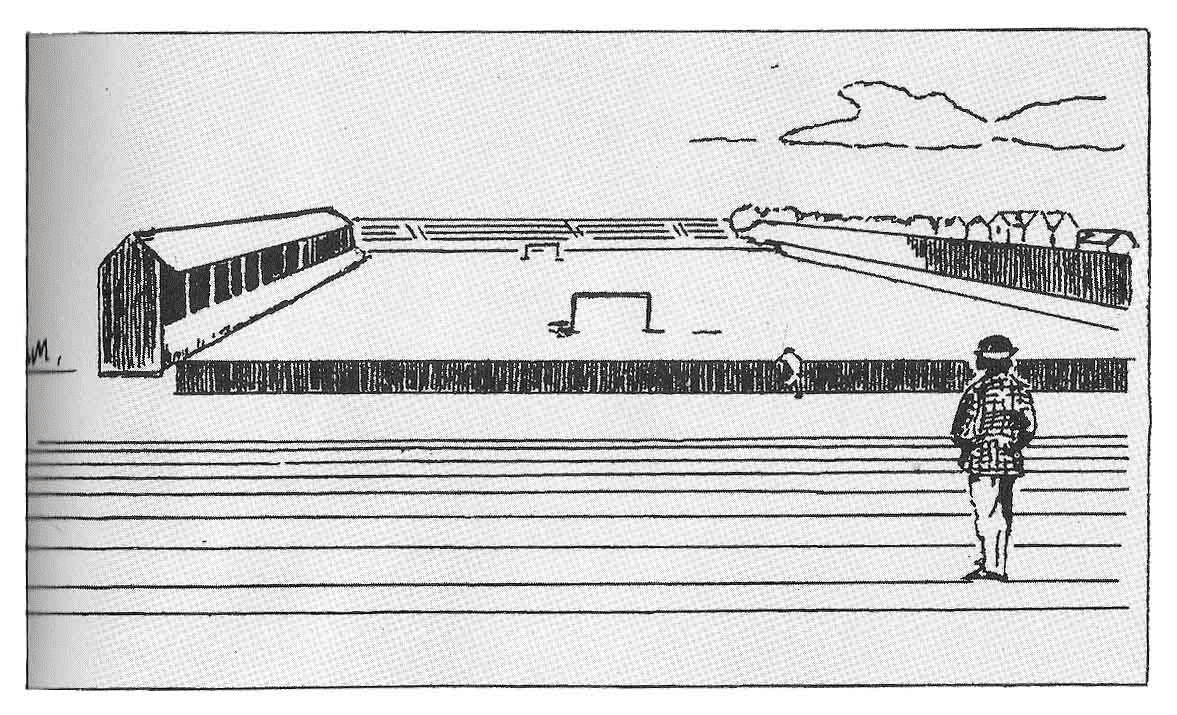
In 1892, a local contractor was tasked with building three stands—two open ones (each with a capacity of 4,000) and one covered one (for 3,000 spectators). The transformation of the wasteland into a modern stadium cost around £3,000. The plan took less than six months to complete, and Everton became the first club in England to have a purpose-built ground, which they initially used on a rental basis.
Everton were able to buy Goodison Park, which fans often call the “Grand Old Lady” (it’s the oldest major stadium in England), in 1895 for a good price—£650 less than Anfield had cost three years earlier. At the same time, Goodison Park was 25% larger in capacity and had a bigger area.
Major structural changes
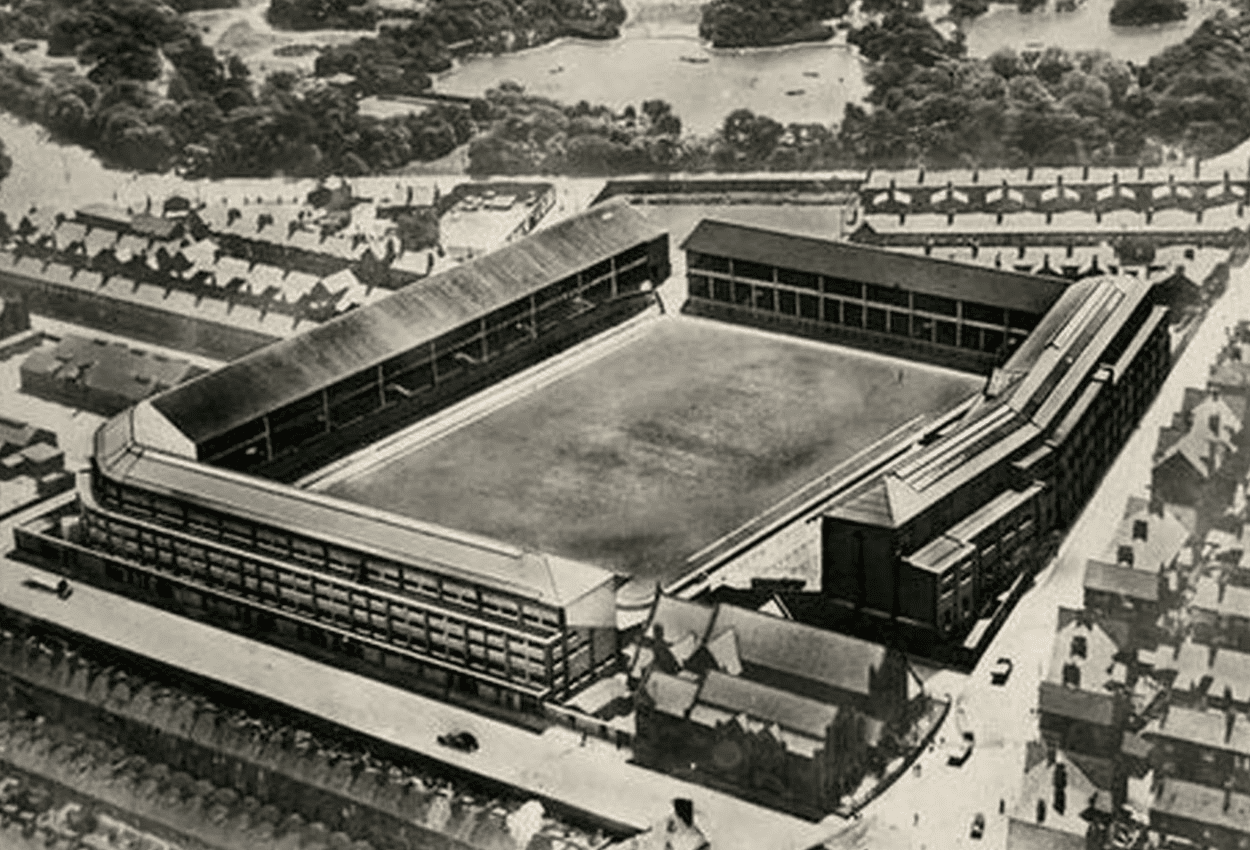
Naturally, stadiums are constantly changing and being renovated. Goodison Park was no exception; it was built in phases.
- 1895 – A new stand, the Bullens Road Stand, was built. The original Goodison Road Stand was also roofed over.
- In 1906, the two-tier Goodison Avenue Stand, designed by Liverpool architect Henry Hartley, was built behind the goal at the southern end of the pitch.
- 1909 – The Goodison Road Stand, designed by architect Archibald Leitch, was constructed. Fans sometimes called the stand the “Mauretania” because of its resemblance to the ship of the same name.
- 1931 – The first dugouts were added to the stadium.
- 1938 – Goodison Park became the first stadium in the country to have two-tier stands on all four sides.
- In the 1930s, Everton became the first club in England to install covered benches for substitutes (following the example of Scottish clubs). Today, this is standard on all stadiums around the world.
- The stadium opened in August 1892 with fireworks, a musical programme, and athletics competitions. The first football match took place here on 2 September, with Everton beating Bolton Wanderers 4-2.
- In 1913, Goodison Park became the first English League stadium to be visited by a reigning monarch—King George V and Queen Mary were in attendance.
- The record average attendance was in 1963 when over 51,600 people watched each game.
- The stadium has hosted many international matches, as well as games for the 1966 World Cup.
Then came the difficult war years, which, unfortunately, did not spare the Everton stadium. One of the stands was damaged by a bomb. But from the 1950s, the arena returned to its usual appearance and even improved.
In 1957, the first match in the history of English football was played here under artificial lighting, provided by four 200-foot floodlight towers. In 1958, Goodison Park became the first stadium in the country with a heated pitch.
In 1971, an electronic scoreboard was installed in the arena, but when Everton beat Southampton 8-0, it was impossible to fit all the goalscorers’ names on it. So, only their numbers were shown. The same year, the renovated Goodison Road Stand was opened, and later modifications were added in line with safety standards, including a full seating conversion.
Interesting facts
Here are a few interesting facts about Goodison Park:
These small details help us understand how important the structure is to the city and the country.
Architectural features of Goodison Park
Compared to Anfield, Goodison Park isn’t very visible from the street. This is especially true after the tall floodlight towers were dismantled.
The main entrance to the stadium is on Goodison Road. On one side of the street are terraced houses, small shops, and the pub The Winslow, while on the other is a high stand wall that comes almost right up to the road, leaving minimal space for the entrances. Above the doors and windows are numerous signs that help spectators find their section.
The Main Stand and its features
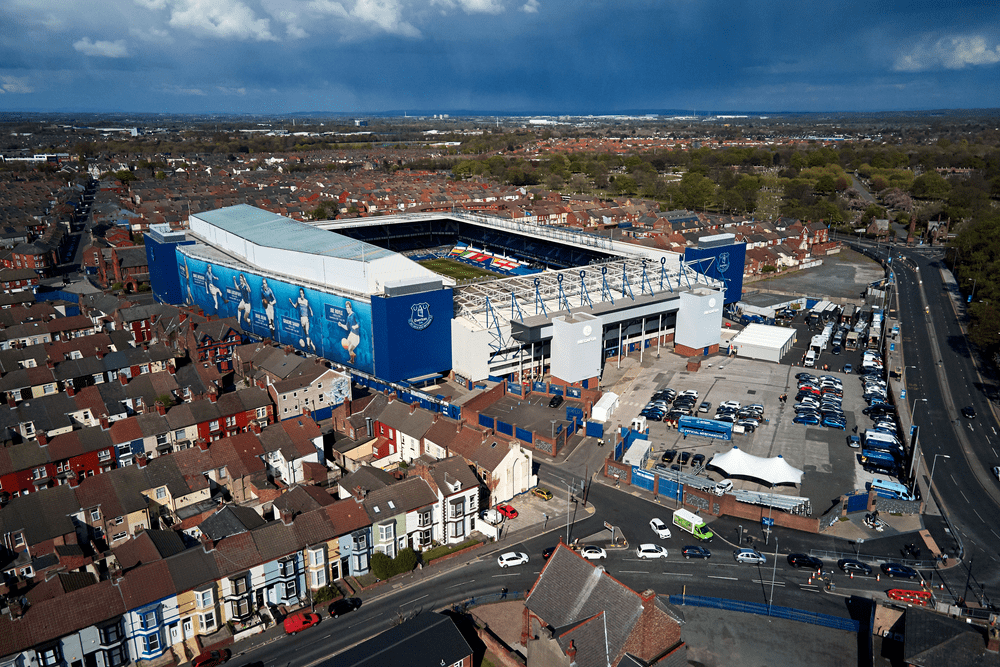
The Main Stand is impressive in its appearance. Its front part, which previously had only standing terraces, now serves as a family section and is partially blocked by a line of executive boxes. These were added later, breaking the stand’s original design. The middle tier contains the directors’ and sponsors’ boxes, and above that is the Upper Balcony.
Because of the angle of Goodison Road, the back wall of the stand near the Park End creates the illusion that the structure is leaning forward. After the construction of the new stand there, the upper rows of seats on the Main Stand are no longer used, as the roof obstructs the view of the goal.
At the corner between the Main Stand and the Park End, there is a tall, rectangular structure painted blue. It serves as an emergency staircase but also darkens this corner of the stadium. The opposite side looks much more impressive—the glass panels, intersected by the line of the Upper Balcony, create a sense of lightness.
Historical details
To the left of the Main Stand is the legendary St Luke’s Church. Its walls come almost right up to the stadium. Everton tried to buy the plot for expansion, but to no avail.
The Gwladys Street End stand, which is located nearby, once accommodated 14,200 standing places, and is now adapted for seating. Its roof merges seamlessly into the roof of the Bullens Road Stand. The latter has three levels, with a characteristic facade design in the style of Archibald Leitch—a blue steel lattice on a white wooden background. The top tier of seats spells out the name “EVERTON” with white chairs among the blue ones.
Modern additions
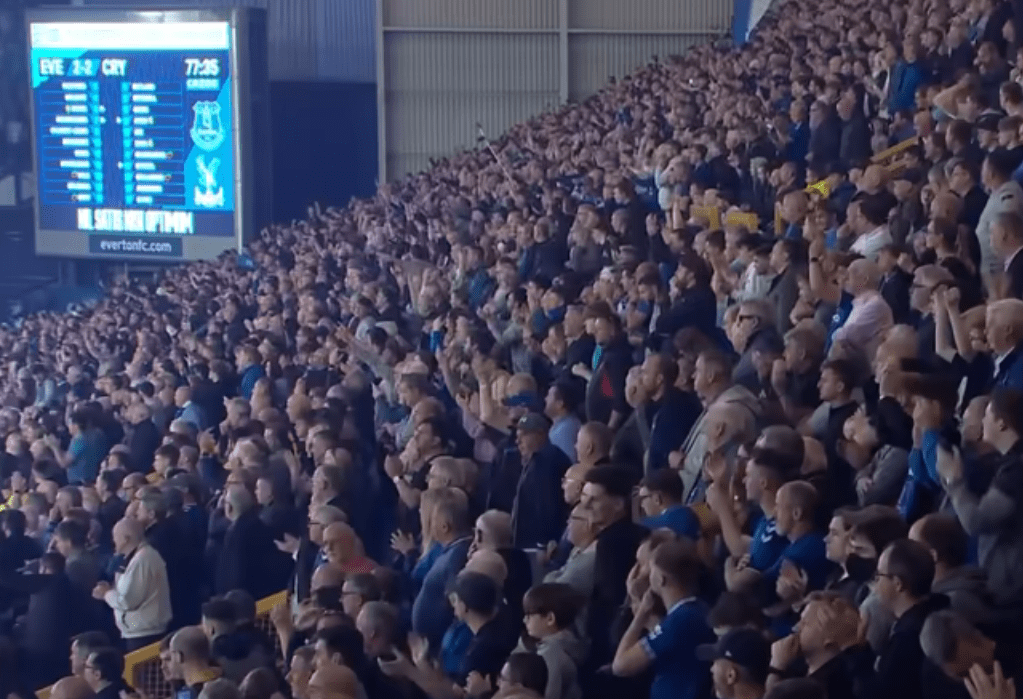
The newest part of Goodison Park is the Park End stand, built in 1994. It is the only one with a single tier and holds 6,000 spectators. Under the roof, there is an electronic scoreboard visible from all sections except the Park End stand.
This stand is not physically connected to either the Bullens Road or the Main Stand, but its roof is level with the Bullens Road roof, creating a visual harmony. The space between the Park End and the Bullens Road allows for ventilation to improve the condition of the pitch and is used for setting up Sky Sports studios for live broadcasts.
The future
It seems that the era of Goodison Park is drawing to a close. This situation came about when Everton started preparing to move to a new stadium on the waterfront in the Bramley-Moore Dock area. The move was necessitated by the inability to modernise Goodison Park due to the limited space, which has saddened many fans.
At the same time, there is reason to believe that the historic arena will not disappear from the city’s landscape—its area will be adapted for office spaces, a residential complex with 150 flats, commercial zones, and a care home. Despite all the changes, Goodison Park will remain in history as an iconic place in British football.