
On the Canary Islands, thousands of miles from England, a “robot astronomer” works around the clock, taking requests from all over the world — without human involvement. This is the Liverpool Telescope, a unique autonomous platform created in Liverpool. In this article on liverpool-future.com, we explain how this telescope became a pioneer of a new era of astronomy, what it can do, and what the future holds.
How It All Began: How Liverpool Created a Unique Telescope
It all started in the mid-1990s when the Astrophysics Research Institute at Liverpool John Moores University set an ambitious goal: to create the largest autonomous telescope in the world. At the time, robotic astronomy was just gaining momentum, and the idea seemed almost fantastical. But in 2003, the Liverpool Telescope saw its first light, and by December 2004, it began operating fully autonomously, without a permanent operator or astronomer on-site. One of the main developers was Professor Mike Bode.
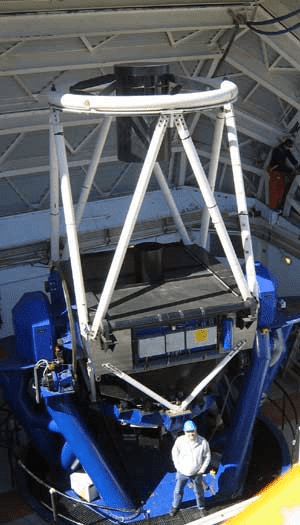
This telescope pioneered an era where scientific observations are conducted without human intervention. How did it succeed? The university first joined forces with the Royal Greenwich Observatory, and together they began developing a system capable of making real-time decisions. In other words, it’s the terrestrial equivalent of a space probe that operates independently.
The chosen location for installation was the summit of Roque de los Muchachos on the island of La Palma — one of the best sites in the world for stargazing. Although the telescope itself is British, the observatory is physically located thousands of miles from Liverpool, and it’s precisely because of this that it has ideal atmospheric conditions.
Today, the Liverpool Telescope is the pride of Liverpool John Moores University and a showcase of British engineering ingenuity in astronomy. The story of its creation is an example of how bold vision and technological determination can take science to a new level.
The Telescope That Works Without People: How the Autonomous System Is Designed
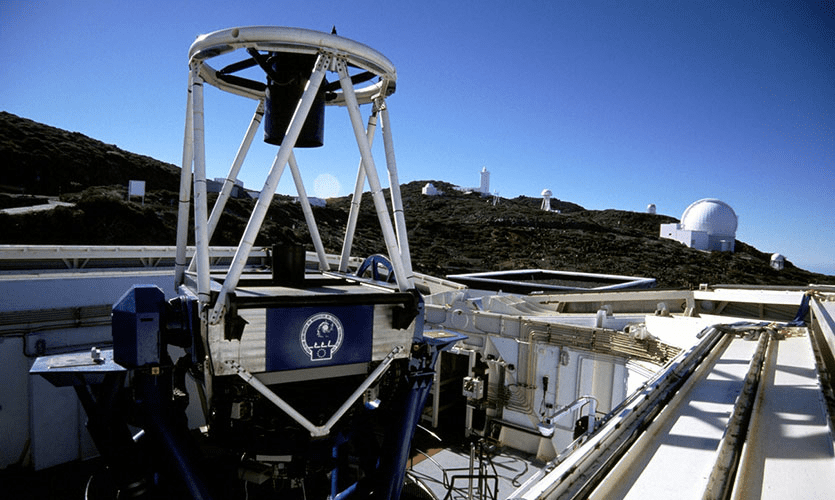
The Liverpool Telescope can do what seemed like science fiction until recently — it can independently plan its work, select observation targets, and change priorities in case of unexpected astronomical events. And it does all this without a single button press by a human.
The “brain” of the telescope is the so-called Robotic Control System (RCS), which functions like an artificial astronomer. Every evening, it analyses a list of requests from researchers, school groups, and other users and forms a queue of tasks. The calculations include the visibility of the object, weather conditions, the priority of the scientific task, moon phases, and the need for specific instruments or filters. This is a complex algorithmic process that allows for the effective use of every minute of the night sky.
The telescope also has the unique ability to react instantly to unexpected events — so-called “Targets of Opportunity.” For example, when a space satellite detects a gamma-ray burst or a new supernova, the Liverpool Telescope system receives a signal and immediately interrupts its current observations to focus on the new object. After this session is complete, the telescope returns to its main schedule — and it all happens completely automatically.
On the technical side, the telescope can simultaneously carry up to nine instruments, including wide-angle cameras, spectrographs, polarimeters, and infrared sensors. Switching between them is also done without human involvement — at the command of the RCS.
Ultimately, the Liverpool Telescope is a truly autonomous scientific employee, capable of making decisions, adapting to circumstances, and working with minimal time loss. There are few similar systems in the world, and the British one is among the first to have proven that autonomy is not a fantasy but a reality.
Astronomy for Everyone: Science, Education, and Global Networks
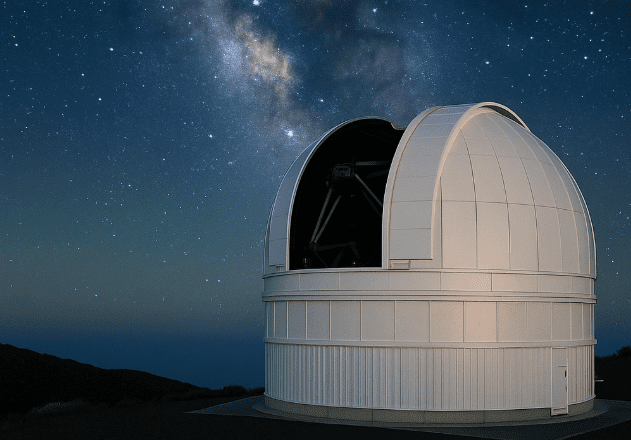
The Liverpool Telescope actively helps science unravel its mysteries. Thanks to its ability to instantly react to flares and variable objects, the telescope participates in the study of the most “hot” events in space: from gamma-ray bursts and supernovae to active galactic nuclei. Its role in the early detection of events is of particular value, as even a few seconds can provide unique scientific data.
One of the ambitious programs involving the telescope is RoboNet. This is a network of robotic telescopes in different parts of the world (including Australia and Hawaii) that are synchronised in real time. In essence, it’s a gigantic “virtual eye” that allows for continuous monitoring of cosmic events across the entire sky. The Liverpool Telescope was the first node of this network and largely set the standard for similar projects.
But its mission is not limited to cutting-edge science alone. Through the National Schools’ Observatory initiative, thousands of schoolchildren in the UK have had the opportunity to submit their own observation requests. This gives students real access to a professional telescope, allowing them to personally explore the Moon, planets, nebulae, or star clusters. This is real science, available right from the school desk.
Such a combination of professional astronomy and education is a rarity in the world. And it is thanks to this that the Liverpool Telescope has become an example of how high technology can not only expand the boundaries of knowledge but also inspire new generations of scientists.
The Future Is Here: The Next Generation of Autonomous Telescopes
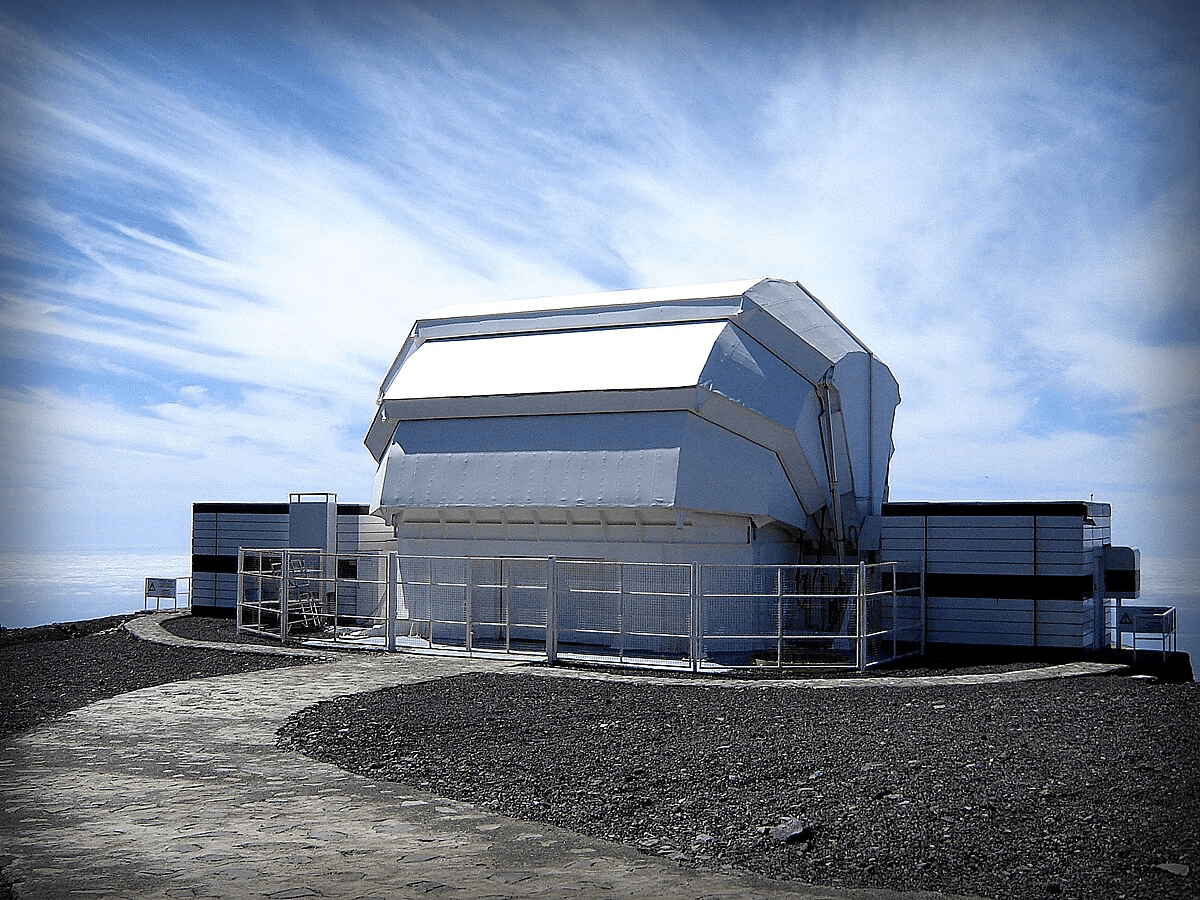
The Liverpool Telescope has been performing complex scientific tasks for over 20 years and remains extremely effective. But astronomy doesn’t stand still. Every year, the volume of information grows, and new tasks appear — for example, observing gravitational waves or events that last for mere seconds. This is why Liverpool has begun developing a successor — the New Robotic Telescope.
This project is valued at £26 million and is being implemented in collaboration between Liverpool John Moores University and the Teide Observatory. The new telescope is planned to be the largest fully autonomous one in the world: its mirror will have a 4-metre diameter, and its reaction time to events will be no more than 30 seconds from signal to the start of observation.
Interestingly, the NRT will be installed on the same mountain as the original LT — Roque de los Muchachos. But the new telescope will not replace the old one; it will work in parallel, complementing it and expanding the capabilities of the British astronomical infrastructure.
Furthermore, future plans include deepening international cooperation: the telescope will be integrated into global networks like LCOGT or the Rubin Observatory, which will enable automatic synchronisation of observations with other objects in real time.
In Conclusion
The Liverpool Telescope is becoming the foundation for a new generation of scientific instruments that allow humanity to look into the Universe more precisely, faster, and more deeply. It is a prime example of how science, engineering, and an educational mission can be combined in one project.
However, it is also interesting that Liverpool is confidently establishing itself as both a cultural centre and a city of technological achievements. By the way, innovation here concerns not only science but also other fields. For example, you can read about how Sampson Moore changed the port industry. As for culture, it’s worth noting the inclusive theatres and the stage without barriers. Thus, in a city where every gaze is directed towards the future, even the stars are not the limit.

